When I visited The National Museum of Emerging Science and Innovation, commonly known as Miraikan, I was struck once again by how interesting it is. Its Japanese name, Miraikan, is a coined term that roughly means “future museum.”
When you think of museums or science centers, what kind of places come to mind? Places lined with dinosaur and animal specimens. Places where you can learn about old inventions and the history of science. Places where you can enjoy science through interactive exhibits. None of these would be wrong. In fact, museums of natural history and the history of science, as well as hands-on science centers, can be found all over the world.
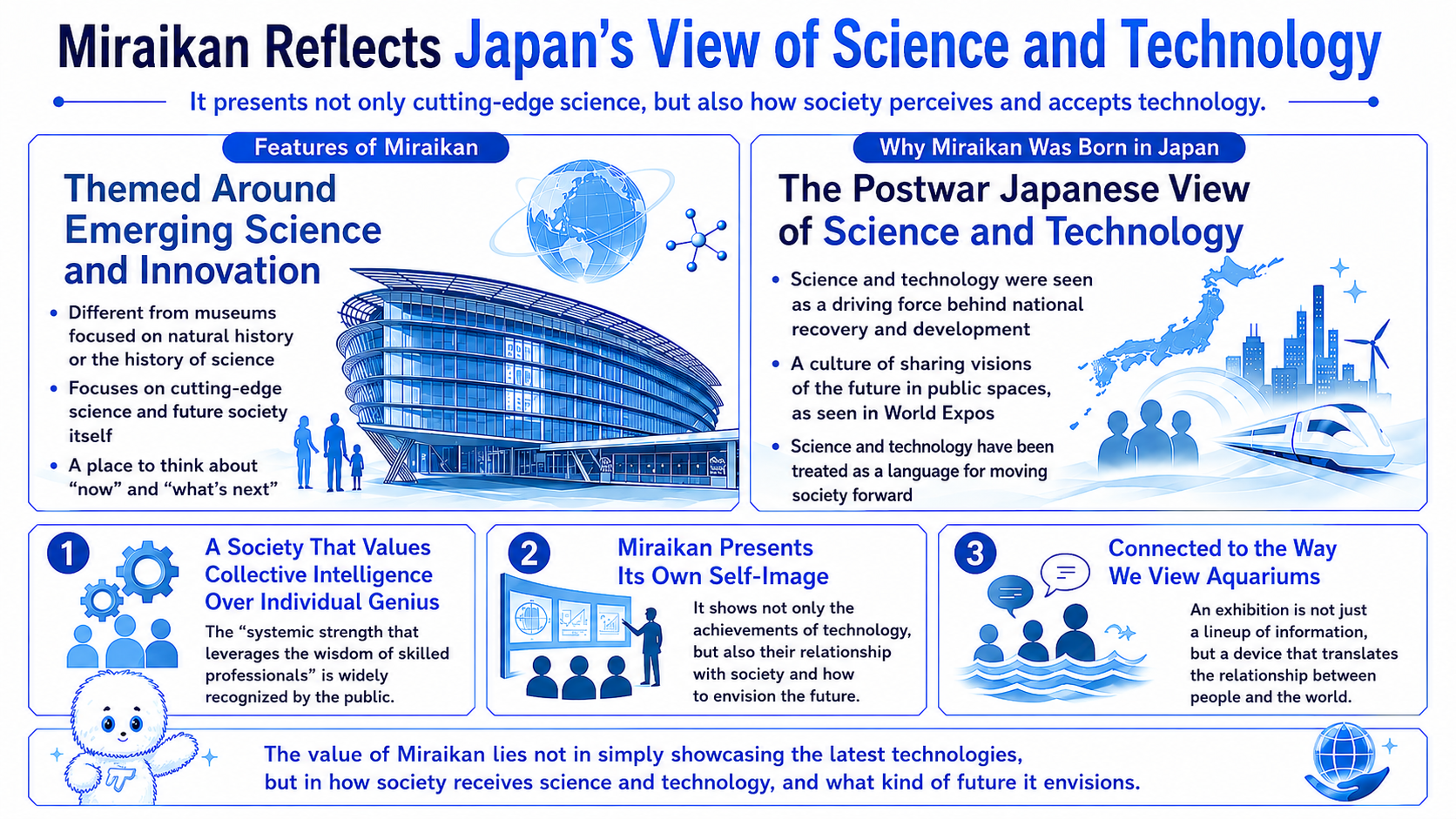
However, large-scale institutions like The National Museum of Emerging Science and Innovation (Miraikan), which place cutting-edge science and future society at the very center of their mission, are quite rare. Moreover, Miraikan is not simply an “unusual science museum.” It also seems to reflect how Japanese society has understood science and technology as part of its self-image.
When I look at aquariums in my everyday work, I do not only look at the rarity of the animals on display. I also look at what the exhibition mediates, and how it is trying to connect people with the world.
In that sense, Miraikan is not unrelated to aquariums. Rather, from the perspective of science communication, it is connected to them at a very deep level.
In this article, I would like to think about that question by using the case of why a place like Miraikan came to exist in Japan.
Why Was Miraikan Born in Japan?
The first thing I felt when I visited Miraikan was that places like this may seem as if they should exist around the world, but in fact there are probably not that many of them. Natural history museums and science museums exist all over the world. Dinosaurs, animals, minerals, outer space, the history of invention. Museums dealing with such subjects are not rare. In fact, just as Japan has places like the National Museum of Nature and Science in Ueno, overseas there are also major institutions such as the California Academy of Sciences, the Smithsonian, and the American Museum of Natural History.
However, institutions like Miraikan, which place cutting-edge science and the shape of society that lies ahead at the very core of their mission, are still somewhat different in character. For example, when I visited, there was the dome theater work The Man from the 9 Dimensions. It is a film that takes as its theme the “theory of everything,” the ultimate goal of physics, and visualizes the world of string theory, one of its leading hypotheses, incorporating topics such as Calabi–Yau manifolds and drawing on the latest scientific data and hypotheses. Miraikan positions this work as something that allows visitors to experience “the forefront of theoretical physics, which would normally only be accessible through equations,” through immersive presentation. In fact, this is the kind of subject matter that would not feel out of place in advanced university courses in mathematics or theoretical physics. A facility that presents such a world directly to general visitors as visual content, and does so head-on within a science museum, is still very rare. Rather than simply lining up the achievements of science, it is trying to create a place where we can think about how to understand what is happening now and how to think about the society to come. That position is highly distinctive.
So why was a place like this able to emerge in Japan? I think this has a great deal to do with Japan’s postwar trajectory. After the war, Japan viewed science and technology not merely as convenient tools, but as central forces supporting the nation’s recovery and development. Of course, this includes many fields such as manufacturing, infrastructure, transportation, and information and communications. But what they all share is that science and technology came to be widely recognized not simply as the domain of specialists, but as a force that moves society forward.
Because of this, I believe Japan was particularly likely to develop a culture in which science and technology are placed at the forefront when speaking about the future. This way of thinking can also be seen, in some respects, in Expo 2025 Osaka, Kansai. The future is not presented as mere fantasy, but shown concretely through science and technology. And that future is shared in a public space. Miraikan, too, becomes easier to understand when seen as part of that lineage.
A Society That Trusts “Collective Intelligence” More Than “Individual Genius”
What matters here is how Japan has looked at science and technology. When people talk about technology, attention often tends to gather around outstanding individuals such as genius inventors or charismatic business leaders. Of course, such people do matter, and Japan has many talented individuals as well. But I think the view of technology that has been more broadly shared in Japanese society is somewhat different.
It is not so much individual flashes of inspiration that are recognized, but rather the “systemic strength that makes use of the wisdom of a group of skilled specialists.” The Shinkansen, for example, is one symbol of this. It was not created by one heroic figure, but by many engineers and people on the ground, each bringing their own expertise together and making the whole system function with extraordinary precision. The same kind of structure can be seen in disaster response or in the maintenance of large-scale social infrastructure. In cinema, Shin Godzilla is, for me, an easy example. One of the attractions of that film was not that a single extraordinary hero solved everything, but that a group of specialists pooled their knowledge and confronted the situation as an organic organization (Organic System).
This feeling seems very close to how science and technology are socially perceived in Japan. In other words, what has been valued in Japan may be not so much the myth of the individual engineer, but the strength of a system that makes collective intelligence function, and that is what I think is important here.
What makes Miraikan interesting is that, while grounded in that view of technology, it also seems to be trying to move beyond it. It does not simply celebrate achievements. It has become a place that asks how those technologies connect to society, how they relate to everyday life, and what kind of future they are helping to create. That is where it gains a depth that differs from a simple display of technology.
This Connects to How I Think About Aquariums
At this point, it may become a little unclear whether I am talking about Miraikan or about aquariums. But in my mind, these two are deeply connected. When I look at an aquarium, I am not only looking at the rarity of the animals or the beauty of the tanks. I pay close attention to what the exhibition is trying to convey, and through what kind of mediation it is trying to reorganize the relationship between people and nature.
For example, one exhibition may place emphasis on conveying knowledge. Another may place emphasis on working on the emotions. Yet another may create an entry point into an otherwise invisible world by making research and conservation efforts themselves visible.
What matters is that exhibitions are not simply places where information is lined up. I myself said in my video introducing the Nagahama High School Aquarium Club that “an exhibition is a dialogue between the people who create it and the people who see it,” and in precisely that sense, I believe that an exhibition is not a display of information, but a device that translates the relationship between people and the world. That is why, in both aquariums and Miraikan, I want to see what the place is trying to translate, and how.
In that sense, Miraikan is a very interesting subject. Living creatures are not at the forefront there, but the relationship between science, technology, and society is translated into a public form through exhibition. And that, in turn, reflects how Japanese society has positioned science and technology, and how it has tried to speak about the future.
To think about Miraikan is also to think about science communication in Japan, and in that way it comes back to the question of how to think about aquariums. I see aquariums not simply as “fun places,” but as places that reopen the relationship between people and nature. And I think that way of seeing probably remains the same when I look at a place like Miraikan. Whatever may be displayed there, what matters is what kind of way of seeing the world it places into the hands of its visitors.
The value of Miraikan does not lie merely in lining up the latest scientific and technological achievements. It is exhibiting the very shape of the imagination through which society receives science and technology, and the kinds of futures it layers onto them. That, I think, is where the real interest of this museum lies. And that is also a question that can be asked of aquariums in the same way.
What is an exhibition?
What is science communication?
What does it mean to deliver knowledge?
Miraikan made me want to think about those questions all over again.

コメント